
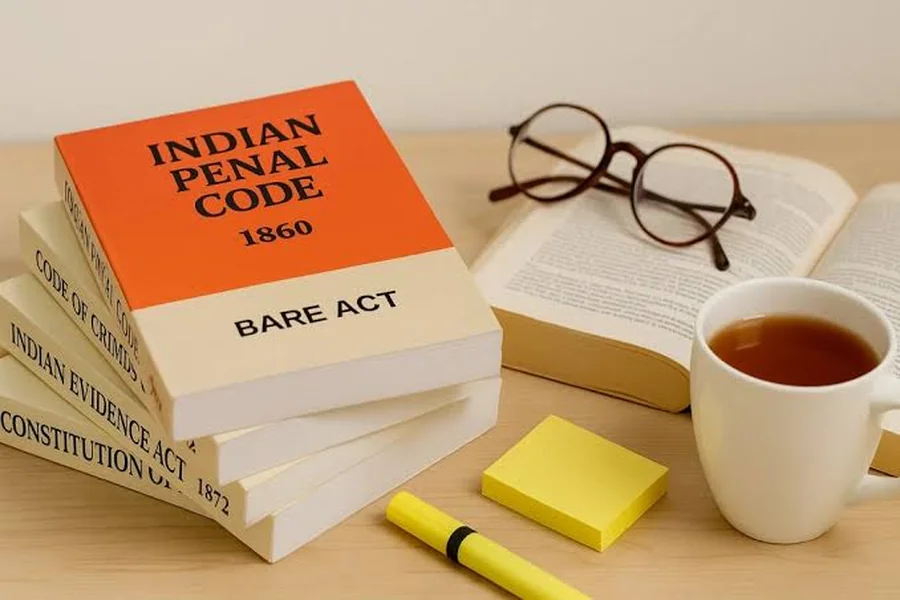
The first few days of judiciary preparation often begin with an expensive pile of books and a difficult question: should you start with the Constitution, the Code of Civil Procedure or the criminal laws? For a new aspirant, judiciary exam preparation for beginners becomes easier when this decision is linked to the state examination you are targeting rather than a generic list of ‘must-read’ Acts.
The best first bare Act is the one that lets you practise a repeatable method. The Constitution of India is a practical starting point for many aspirants because it introduces institutions, rights and legal language that recur across law subjects. But this is a foundation suggestion, not a universal rule: if your state notification assigns heavy weight to a different subject, your study sequence should reflect that.
The first task is to choose the recruitment notification
Every state’s judiciary syllabus deserves a separate checklist. The paper structure, subject weighting, language requirements and local laws vary. A subject common in one prelims syllabus may carry little or no weight in another. Download the latest official notification and make three columns: prelims subjects, mains subjects and state-specific additions.
Do not ignore eligibility while planning. Judicial-service entry rules have undergone important litigation and transitional changes. The Supreme Court’s 2026 transitional directions address the practice requirement for recruitment notifications issued up to 31 March 2027; applicants should check the current court directions and the relevant state’s advertisement rather than relying on broad statements that all new graduates are either eligible or ineligible. The eligibility question is distinct from how to study a statute, but it affects which recruitment cycle you can realistically target.
A sensible reading order for someone starting from zero
Stage one: Constitutional Law. Begin with the Preamble and the structure of the State, then Fundamental Rights, Directive Principles and the courts. Read each provision in its statutory language before a commentary book. In the margin, note the keywords that would change an answer: ‘shall’, ‘may’, ‘subject to’, ‘notwithstanding’ and ‘reasonable’.
Stage two: one procedural law. The Code of Civil Procedure is useful for understanding the sequence of a civil case: institution, pleadings, summons, interim relief, evidence, judgment and execution. The aim is not to memorise every Order in one sitting; it is to form a map of where each concept belongs.
Stage three: criminal-law framework. Study Bharatiya Nyaya Sanhita, Bharatiya Nagarik Suraksha Sanhita and Bharatiya Sakshya Adhiniyam where prescribed, with attention to the legacy IPC, CrPC and Evidence Act terminology that older papers may still contain. Avoid mixing provisions from different laws without checking which code the current question refers to.
Stage four: high-weight substantive laws and local Acts. Contract, Specific Relief, Transfer of Property and state-specific statutes should enter the plan according to the examination syllabus. A high-yield local Act may justify earlier revision than a large national statute with limited marks in your selected examination.
How to read bare Acts without getting lost
Students often ask how to read bare Acts as though there is a secret speed-reading technique. In practice, a good method has five passes. First, read the short title, applicability and definitions. Second, mark the operative rule. Third, find exceptions and provisos. Fourth, connect the section with the next procedural step or related provision. Fifth, test the wording with two short questions.
Suppose a provision says that a court ‘may’ grant a remedy subject to listed conditions. A hurried reader remembers only that the court ‘grants’ the remedy; a careful reader notices discretion and conditions. In a prelims question, the difference between ‘may’ and ‘shall’ may be the entire challenge. In a mains answer, overlooking the condition can distort the legal conclusion.
Use a small section notebook with four headings: rule, conditions, exception and example. Writing a full paragraph from memory after reading a chapter is less useful than being able to identify these four components reliably.
The first ten days: a realistic starter schedule
On days one and two, read the relevant syllabus and create your book list. On days three and four, study constitutional definitions and the overall structure. Days five and six can cover a selected group of Fundamental Rights articles with simple hypotheticals. Day seven is for revision and ten to fifteen objective questions. Days eight and nine begin one procedural law’s outline, while day ten is reserved for correcting mistakes and updating your schedule.
Study sessions can follow a 40-20-20 pattern: forty minutes with the bare Act, twenty minutes with a concise explanatory text and twenty minutes of practice. Beginners who have more time can repeat the cycle; working aspirants can shorten it proportionally. What matters is preserving all three stages: source, explanation and application.
Choosing judiciary preparation books without buying everything
The right judiciary preparation books complement the statute rather than replace it. Select one principal commentary or exam-oriented text per major subject, then add previous-year questions and a well-maintained notebook. A library full of overlapping guides increases the time spent comparing explanations instead of learning law.
For constitutional questions, consult a recognised constitutional-law text when the statutory wording needs context. For CPC and other procedural laws, use a text that clarifies the litigation sequence and common examination issues. For criminal laws, make sure your resource is updated for the newer codes and clearly distinguishes old and new provisions where relevant.
Before buying a book, check its publication date, edition, accuracy of section numbering and suitability for your state paper. Older texts can still explain enduring legal principles, but they should not be treated as an accurate summary of a recently amended statute.
Prelims and mains require different reading habits
Prelims questions frequently test definitions, exceptions, numerical limits, time periods and precise language. That requires close reading and frequent recall. Mains questions ask whether you can explain a rule, apply it to facts, distinguish authority and conclude clearly. Reading only for prelims can leave a candidate unable to construct an answer; reading only for mains can leave statutory exceptions unmemorised.
After a chapter, create two prompts. One should be a factual MCQ-style question about the text. The other should ask for a short legal analysis of a hypothetical situation. This paired approach makes every hour with the bare Act serve both stages.
How much coaching does a beginner need?
Online judiciary coaching is useful when it supplies a coherent state-specific plan, faculty explanations, updated laws, evaluation of mains answers and feedback on mistakes. It is less useful if the learner passively watches hours of lectures without opening the bare Act. Compare programmes by asking whether faculty show the actual section during class and whether students receive correction on written answers.
Judiciary Gold by Toprankers offers judiciary preparation programmes covering prelims, mains and interviews. Its online judiciary coaching page is one place to compare the current course structure. Whether learning independently or with mentors, every serious aspirant should maintain ownership of their statute notes and revision schedule.
Three mistakes that delay the first month
First, starting with a dozen subjects at once creates the illusion of coverage while leaving nothing retrievable. Second, underlining entire pages makes future revision almost as slow as first reading. Third, using old state question papers without checking legal changes can teach outdated section references. Fix these with a rotating schedule, selective margin notes and a separate current-law update sheet.
A fourth mistake is measuring progress only in pages. A candidate who can explain ten provisions accurately may be better prepared than one who has highlighted fifty without recalling their conditions. Track retention and application instead of page count alone.
Final perspective
For judiciary exam preparation for beginners, begin with the official state syllabus and a manageable first statute. The Constitution is often a strong starting point, but the specific sequence should respond to your target examination. Read the words of the law, test each condition and exception, and begin simple answer writing earlier than you think. The goal of the first month is not to become an expert in every subject. It is to build a method capable of supporting years of careful legal study.