
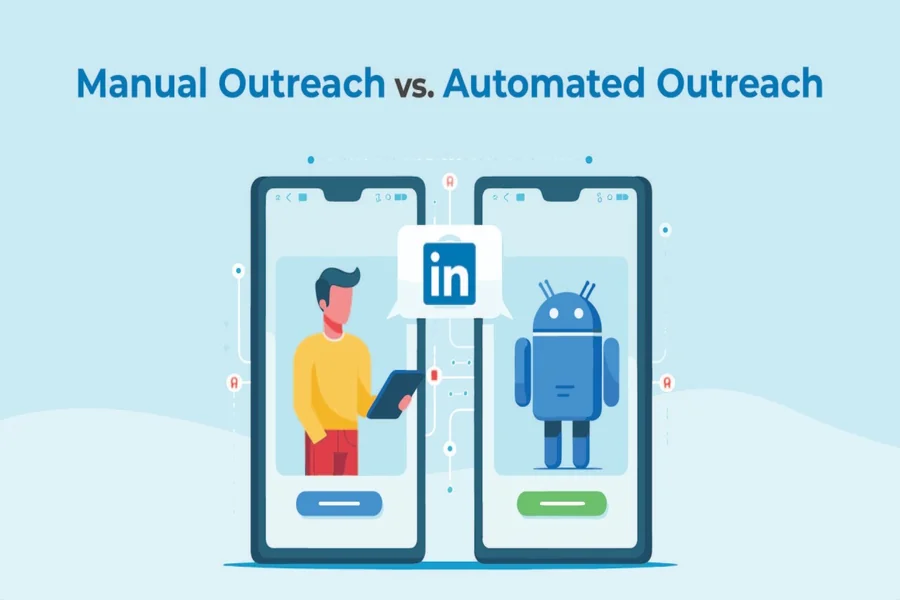
Collecting reliable LinkedIn data is now a critical part of sales, recruiting, and market research. But there is an ongoing debate: is it better to rely on careful manual research, or to lean on automated scraping tools? The real answer sits somewhere in the middle—where strategy, compliance, and smart tooling meet.
What Do We Mean by “Manual” vs “Automated”?
Manual LinkedIn research usually means a human opening LinkedIn, searching profiles or companies, and then copying relevant data into a spreadsheet or CRM. It can also include using built-in LinkedIn features like filters, lists, and notes.
Automated LinkedIn data collection involves using software to systematically gather specific data points at scale—job titles, locations, industries, company headcount, and more. Tools like LinkedinScraper sit in this category, helping users extract structured data while trying to respect platform and legal constraints.
Both methods seek the same outcome: accurate, actionable information about people and organizations. The difference lies in speed, scale, control, and risk.
The Strengths of Manual LinkedIn Research
Manual work is slower, but it has unique advantages that automation still struggles to match.
1. Human context and nuance
Humans are good at interpreting nuance: understanding what a vague job title really means, seeing whether someone is actually a decision-maker, or noticing subtle cues like how active they are on the platform.
- Spotting red flags in profiles (incomplete, out of date, clearly misaligned).
- Interpreting unusual career paths or hybrid roles.
- Judging whether the tone of a profile matches your brand or culture.
2. Higher precision for small, high-value targets
If you only need 50 extremely high-value prospects for an enterprise deal or executive search, manual research can be ideal. You can deeply review each profile, verify details, and even cross-check with other sources such as company sites or press releases.
3. Flexible on-the-fly decisions
Manual researchers can adapt in real time: refine queries, pivot to a new niche, or follow interesting lead paths that a rigid scraper would ignore. That kind of improvisation often reveals unexpected opportunities.
4. Lower technical and compliance complexity
With manual work, you are using LinkedIn as intended. You still need to follow the platform’s terms and privacy laws, but you are less likely to run into issues with automated behavior, blocked accounts, or rate limits.
The Downsides of Manual LinkedIn Research
The biggest problem with manual collection is obvious: humans do not scale well.
1. Time-consuming and repetitive
Copying names, titles, and URLs one by one is slow and tedious. For a sales or recruiting team, that time could be better spent on outreach and relationship building instead of data entry.
2. Error-prone and inconsistent
Even diligent researchers make mistakes: typos, skipped rows, misaligned columns, or forgetting to record a crucial field. Different team members might categorize roles or industries differently, leading to messy, inconsistent data.
3. Difficult to keep data fresh
LinkedIn is dynamic. People change jobs, titles, and locations frequently. Manually refreshing large lists becomes almost impossible once you cross a few thousand records.
Where Automated LinkedIn Scraping Shines
Automation exists for a reason: it unlocks volume and speed that humans cannot match, when used responsibly.
1. Massive productivity gains
Used correctly, a tool like LinkedinScraper can turn a full day of manual copy-paste into a task that takes minutes.
- Collect hundreds or thousands of profiles in one run.
- Extract structured data (name, title, company, location, URL, industry, and more) into a clean format.
- Feed that data directly into a CRM or analytics workflow.
For teams that run repeatable campaigns—outbound sales, recruiting for similar roles, or market mapping—the time savings add up quickly.
2. Better consistency and standardization
Automation applies the same logic to every profile it touches. If you configure your fields and formatting well, you get cleaner, more standardized datasets than you would from a group of humans doing manual entry.
3. Easy replication and scaling
Once you have a working scraping workflow, you can reuse it:
- Run weekly updates on the same search criteria.
- Replicate the setup across regions or verticals.
- Measure performance across campaigns using consistent data structures.
This repeatability is what makes automation powerful in growing organizations.
The Trade-Offs and Risks of Automated Scraping
Automation is not a free lunch. Without care, it can introduce new risks and blind spots.
1. Compliance and terms-of-service considerations
LinkedIn has clear rules against certain types of automated access. Scraping that ignores these rules can lead to:
- Account restrictions or bans.
- Legal or contractual risks for your company.
- Reputational damage if data is collected or used irresponsibly.
Responsible tools—and responsible users—work within rate limits, respect privacy and local law, and focus on legitimate use cases such as research, analytics, or first-party enrichment.
2. Lack of nuance and context
Scrapers are great at grabbing fields, but they do not truly “understand” profiles. They may:
- Misclassify unusual job titles.
- Miss context hidden in the “About” section or experience details.
- Overlook whether someone is actually influential or merely has a similar title.
For high-stakes outreach, raw scraped data still needs a human layer of review and interpretation.
3. Data quality issues if misconfigured
Bad filters in, bad data out. If you set up your search criteria poorly or map fields incorrectly, you can end up with a large but unusable dataset. Unlike manual research, where errors are localized, automated errors scale fast.
Real-World Productivity Gains: Manual vs Automated
To see the difference, consider a few realistic scenarios.
Scenario 1: Building a 500-contact prospect list
- Manual: Finding and recording 500 relevant contacts can easily consume 1–2 full workdays for a single person, especially if they check each profile for fit.
- Automated with a tool like LinkedinScraper: Setting up filters and running the scraper might take 30–60 minutes, with a few additional hours for data cleaning and spot-checking. Overall, you can often save 60–80% of the time.
Scenario 2: Ongoing market monitoring
If you need to track hiring trends in a niche (for example, new VP of Sales hires at B2B SaaS companies):
- Manual: Requires periodic manual searches and checks, which are easy to forget or deprioritize.
- Automated: A recurring scraping workflow can capture new profiles or changes regularly, feeding dashboards or alerts with minimal ongoing effort.
Scenario 3: Executive or niche hiring
For a highly specialized executive search with fewer than 50 viable candidates worldwide:
- Manual: Recruiters can afford to inspect each candidate deeply, cross-check data, and build a short, curated list.
- Automated: Scraping may help to generate an initial long list, but final selection still relies heavily on human judgment.
In other words, automation provides leverage, but humans provide direction and final quality control.
Finding the Right Balance: A Hybrid Approach
The most effective teams rarely choose between manual and automated methods; they combine them intelligently.
Use automation for volume and structure
- Generate large lists of potential prospects or candidates based on clear, repeatable criteria.
- Standardize key data fields so they can be sorted, filtered, and analyzed easily.
- Refresh existing datasets periodically to keep them from going stale.
Use manual research for depth and validation
- Spot-check a subset of profiles to verify that your filters and scraper configuration are producing the right kind of contacts.
- Manually review and enrich high-value segments: top-tier accounts, executive-level candidates, or strategic partnerships.
- Add qualitative notes that scrapers cannot capture: culture fit, communication style, or recent activity.
Build ethical and compliant workflows
Whichever approach you use, it is essential to:
- Respect LinkedIn’s terms of service and rate limits.
- Comply with privacy regulations in your jurisdiction (for example, GDPR in the EU).
- Use scraped or collected data only for legitimate, value-creating purposes.
Modern tools designed for responsible use, such as LinkedinScraper, aim to balance the need for efficiency with these constraints, but ultimate responsibility lies with the user and organization.
So, What Works Better?
Neither manual nor automated LinkedIn data collection is universally “better.” Each excels under different conditions.
- Choose manual research when precision, nuance, and human judgment matter most: small, high-value lists, complex roles, or sensitive outreach.
- Choose automated scraping when you need scale, speed, and structure: larger prospecting campaigns, recurring market analysis, or systematic data enrichment.
In practice, the most productive teams blend both: using automation to handle the heavy lifting of data collection and manual effort to refine, interpret, and build real relationships from that data.
Viewed this way, the question is not “manual vs automated,” but rather how to design a workflow where each plays to its strengths—and where tools like LinkedinScraper amplify, rather than replace, human insight.