
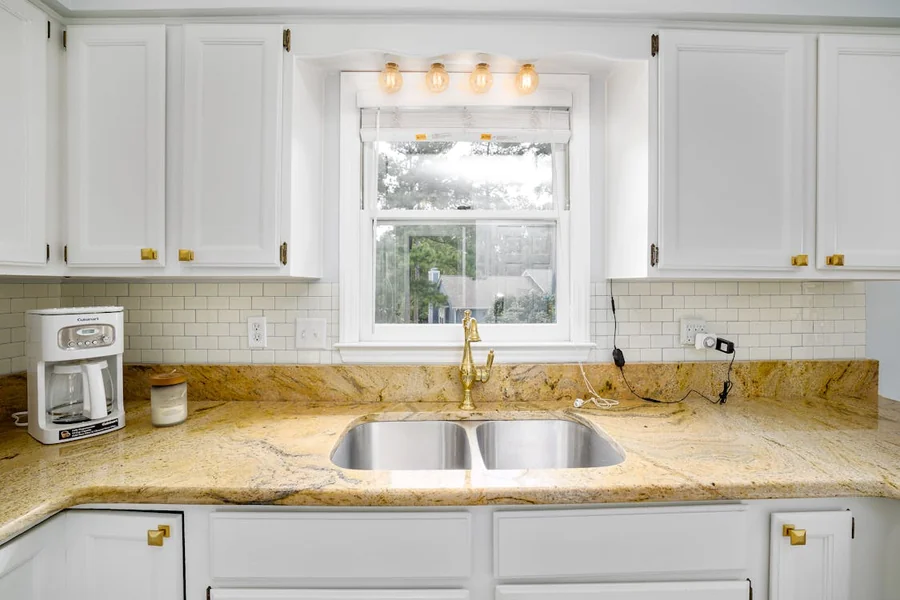
Here’s a confession most renovation guides won’t make upfront: subway tile is fine. It just isn’t interesting. If you’re putting real time and money into a kitchen refresh, the backsplash deserves better than “fine.” It’s one of the only surfaces in the room that has to work three jobs simultaneously, protection, style, and daily function, and it’s too visible to get wrong.
A Houzz study found that more than 4 in 5 homeowners (85%) make the backsplash a priority during kitchen renovations. That number isn’t surprising once you’ve spent time cooking in a kitchen where the backsplash feels like an afterthought.
One surface. Enormous impact. The goal of this guide is to move you past the predictable options and into territory that holds up, aesthetically and physically, for years.
Before jumping into specific materials and layouts, there’s a foundational framework worth understanding. Every designer who produces a kitchen that looks genuinely custom applies some version of it.
Modern Kitchen Backsplash Ideas That Look Custom (Without Feeling Trendy-Fast)
A strong modern kitchen backsplash doesn’t just photograph well, it survives five years of steam, splatter, and shifting design tastes without looking dated.
The instinct to chase trends is understandable, but the backsplashes that age best follow a reliable design logic. Understanding that logic before you pick a single tile saves both money and regret.
The “Modern” Formula Designers Actually Repeat
Most designers work from a 60/30/10 balance: a neutral field tile or slab covers the majority of the surface, a secondary material or texture adds dimension, and one deliberate accent zone, usually the range wall or sink wall, anchors the whole composition.
Fewer grout lines, consistent finishes, one intentional focal point. Those three variables separate kitchens that look custom from ones that look assembled. When those elements align, even budget-tier materials read expensive.
Fast Style-Matching Guide (Pick Your Path)
You don’t need weeks of research to find the right direction. Minimal kitchens lean toward large-format matte tile, microcement, or slab.
Warm modern kitchens respond well to zellige-inspired glazed ceramics, creamy stone, or sealed wood slats. Bold kitchens suit checkerboard, terrazzo, or high-contrast stone veining. Industrial kitchens look sharp with stainless steel, ribbed metal, or concrete-look porcelain.
Now that the logic is clear, it’s time to get into the actual treatments, starting with the most architectural option on the list.
Unique Kitchen Backsplash Ideas (The Standout List for Modern Homes)
These aren’t pulled from a mood board and called a day. Each option here covers what it works best for, which materials to use, how it performs over time, and one pro tip that elevates execution. If you’ve been hunting for unique kitchen backsplash ideas that go well beyond standard rectangular tile, this is the list worth saving.
Counter-to-Ceiling Slab Backsplash
Best for: Ultra-modern kitchens and households that want the easiest possible wipe-down.
Materials: Quartz, quartzite, porcelain slab, sintered stone.
Pro tip: Extend the slab behind the hood and wrap the side walls for a fully built-in effect. Bookmatching two slabs creates a dramatic mirror-image pattern that looks genuinely architectural, the kind of detail that makes people stop mid-conversation to ask about it.
Counter-to-Wall “Countersplash”
If a full slab feels beyond your budget or space, the countersplash approach delivers the same seamless, grout-free result at a more targeted scale. The countertop material simply continues up the wall, usually eight to eighteen inches, blurring the line between surface and backsplash in a way that reads intentional rather than incomplete.
Pro tip: Add a thin ledge or shelf detail in the same stone for both function and visual rhythm.
Fluted and Ribbed Tile for Shadow-and-Depth Texture
Where the countersplash wins on simplicity, fluted tile wins on dimension. It’s the go-to upgrade for kitchens that feel a little too flat or one-note.
Best for: Modern kitchens that lack textural contrast.
Pro tip: Running the flutes vertically lifts ceiling height visually in a way horizontal orientation simply cannot match, subtle geometry doing serious work.
Zellige-Inspired Glazed Tile in a Modern Layout
Fluted tile adds texture through form. Zellige-inspired tile adds it through light-catching, handmade variation, every piece slightly different, which is precisely the appeal.
Best for: Warm modern and organic modern aesthetics.
Pro tip: Choose a tight color family, cream, greige, or soft sage, and pair it with a calm, tone-matched grout to keep the variation feeling curated rather than chaotic.
Checkerboard Backsplash (Micro-Checks for Modern Homes)
If zellige feels too soft for your kitchen’s personality, the checkerboard delivers a pattern with graphic punch. Done right, it feels retro-smart rather than retro-kitschy.
Best for: Modern-retro kitchens that want energy without feeling dated.
Pro tip: Keep cabinet fronts flat and hardware minimal. Let the pattern carry the wall, it doesn’t need help.
Terrazzo Backsplash
For kitchens that want color without committing to a single bold hue, terrazzo offers a sophisticated middle ground. Small aggregate reads refined and contemporary. Larger aggregate reads as more playful.
Pro tip: Pull one chip color from the terrazzo into your hardware or counter stools to tie the design together without overworking it.
Stainless Steel Backsplash
At the opposite end of terrazzo’s warmth, stainless steel strips everything back to pure function and industrial precision.
Best for: Heavy-cooking households that need near-indestructible surfaces.
Pro tip: Choose brushed or satin finish to minimize visible fingerprints, and add under-cabinet lighting to give the material a warm, intentional glow rather than a clinical one.
Large-Format Porcelain Tile Panels
If the sculpted stone look appeals but the budget doesn’t stretch that far, large-format porcelain panels deliver a nearly identical slab-like result at a fraction of the cost.
Pro tip: Align tile veins with the countertop direction to create visual continuity across the whole surface, a small alignment detail with a large payoff.
Mixed-Material Backsplash Zoning
According to NKBA’s 2025 Kitchen Trends Report, 67% of respondents agree that mix-and-match backsplashes add a unique touch to the kitchen. Rather than picking one material and running it everywhere, zoning assigns the right surface to each area, stone behind the range, tile at the sink, so each zone performs its specific job well.
Pro tip: Keep thickness transitions clean with trimless detailing wherever materials meet. A messy transition will undermine even the most premium material pairing.
Back-Painted Glass Backsplash
Where sealed wood adds warmth and texture, back-painted glass takes the opposite position: smooth, reflective, completely grout-free.
Best for: Minimalist kitchen backsplash ideas where every seam and smudge is visible.
Pro tip: Color-match the glass to the cabinet paint for a seamless monochrome wall that makes the room feel taller without touching a single structural element.
Gradient and Ombré Tile Layout
Where a tiled frame creates intentionality through borders, a gradient creates it through movement, a slow visual shift from one tone to another that reads artistic without being aggressive.
Best for: Creative kitchen backsplash ideas that stay firmly on the refined side.
Pro tip: Keep cabinetry fully neutral. The gradient itself is the feature, and it doesn’t need competition from pattern or color elsewhere in the room.
3D Geometric Tile (Matte Finish for Modern Homes)
If gradient appeals because of its sculptural quality, 3D geometric tile takes that instinct further, delivering actual physical depth and shadow-play that no flat surface can replicate.
Pro tip: Limit 3D tile to one wall, usually the range wall, to avoid visual fatigue across the whole kitchen.
Choosing the right style is only half the equation. The other half is making sure that choice actually works within your specific kitchen’s dimensions and flow.
Backsplash Ideas for Modern Homes by Kitchen Layout
The best backsplash ideas for modern homes always account for the actual room they’re going into. A choice that looks stunning in a large open-concept kitchen can feel suffocating in a narrow galley. Layout logic matters just as much as material selection, and sometimes more.
Open-Concept Kitchens
Prioritize a larger scale here. Slabs, large-format tile, or bold patterns with restraint. Extending the backsplash to ceiling height on the focal wall prevents the “floating strip” effect that makes an otherwise excellent kitchen look unresolved when viewed from across the room.
Small Kitchens and Galley Kitchens
Small kitchens benefit from vertical tile orientation, reflective glass, lighter grout, and fewer seams, all strategies that make a space feel expansive rather than compressed. Galley kitchens face a different challenge: avoiding the visual tunnel effect.
That means slab, countersplash, or oversized simple tile is almost always the right call. Patterns should stay minimal in a galley so the layout doesn’t feel narrower than it already is.
Kitchens with Low Uppers or Open Shelves
When upper cabinets are minimal or absent, the backsplash has to work much harder as a finished wall surface. Plan outlet locations and shelf bracket placements before installation begins, awkward cuts made after the fact are nearly impossible to fix cleanly.
Color and Finish Pairings That Make a Modern Kitchen Backsplash Look Designer
The same tile can read builder-grade or bespoke depending entirely on how color and finish decisions are made. Warm whites, mushroom, soft taupe, and muted clay tones form the backbone of modern neutral palettes that resist looking generic over time.
The pairing rule is simple: warm cabinet tones call for warm grout; cool cabinet tones call for cool grout. Mixing those undertones is one of the most common reasons a backsplash that looks right in the showroom feels slightly off once it’s installed at home.
High-Contrast Modern Pairings and Finish Strategy
High-contrast combinations, black paired with off-white, walnut with cream, deep green with brushed brass, deliver real drama, but only when the contrast lives in one place. Either the stone veining is bold, or the tile pattern is bold, or the cabinet color is bold. Rarely all three at once.
For finish selection: matte finishes feel calm and hide smudges well. Gloss finishes bounce light and emphasize handmade variation beautifully. Honed stone sits between the two, modern softness without the glare of polished surfaces.
Smart Material Selection (Durability, Cleaning, and Real-Life Performance)
Great aesthetics mean nothing if the material can’t survive daily cooking reality. Stainless, porcelain panels, quartz, sintered stone, and glazed ceramic are the most reliable choices for heavy cooking zones, they handle heat, oil splatter, and frequent wiping without degrading.
Low-Maintenance Choices and Budget Tiers
For busy households, slabs, large-format tile, and epoxy grout dramatically reduce cleaning complexity. A daily wipe, a weekly degrease, and a seasonal grout seal schedule are all most kitchens need.
Budget-conscious projects can achieve a high-end look with large ceramic tile or zellige-look ceramic. Mid-range projects gain from porcelain panels and specialty shapes. Premium projects add quartzite or marble slabs, bookmatching, and custom niches, materials and details that genuinely can’t be replicated at a lower price point.
Installation Details That Separate “Okay” from Architectural
Even premium material looks mediocre with poor installation. Thin grout lines read contemporary.
Color-matched grout creates a seamless field. Contrast grout creates an intentional graphic. At the edges, metal trims in brass or matte black, mitered corners, and stone returns give a backsplash the finished, architectural quality that separates a truly great kitchen from one that’s merely competent.
Under-cabinet LED lighting at a warm-to-neutral temperature brings out material depth. Grazing light across fluted or 3D tile emphasizes every shadow line in the texture, a lighting decision that costs relatively little but pays off visually every single day.
Common Design Mistakes That Date a Modern Kitchen Backsplash Fast
Too many competing focal points is the most common issue, bold stone veining, a busy tile pattern, and colorful cabinets all fighting for attention at once. Pick one hero element and let everything else support it.
Short backsplash height is the other frequent mistake. A strip of tile that stops abruptly below upper cabinets reads unfinished in modern kitchens, particularly with the trend toward taller or fewer uppers.
Finally, trend-only picks without a longevity plan carry real risk. The fix is to make the base material timeless, slab, neutral field tile, and reserve the changeable accents like hardware, art, and counter stools as the trend-responsive elements. That way, refreshing the kitchen five years from now doesn’t require tearing out anything structural.
Frequently Asked Questions
Are slab backsplashes worth it in a modern kitchen, and do they crack easily?
Slab backsplashes are absolutely worth it for low-maintenance modern kitchens. Quartz and sintered stone resist cracking under normal conditions. Proper support during installation and flexible adhesive are the keys to avoiding stress fractures over time.
Should a modern kitchen backsplash go to the ceiling or stop at the cabinets?
Going to the ceiling on the focal wall, usually the range wall, creates a strong architectural statement and avoids unfinished-looking gaps. Stopping at the cabinets works fine everywhere else, as long as the top edge has a clean, intentional finish.
What backsplash looks best with white cabinets and quartz countertops in modern homes?
Warm-toned stone-look tile, zellige-inspired ceramic, or a subtle fluted panel in soft white or greige all work beautifully. The goal is to add texture or organic variation without fighting the clean simplicity of white cabinetry.
Modern Kitchen Backsplash Design
A well-chosen backsplash does more for a modern kitchen than almost any other single update. It defines the tone, protects the walls, and gives the room a personality that flat cabinetry alone simply cannot provide.
Whether the right move turns out to be a dramatic counter-to-ceiling slab, a warm zellige-look tile, or a mixed-material zone that solves two problems at once, the best choice is always the one that fits how you actually cook, clean, and live in your kitchen.
Don’t overthink it. Pick the direction that genuinely excites you, apply the logic this guide has laid out, and build from there. Your kitchen will thank you for the next decade.