
Introduction
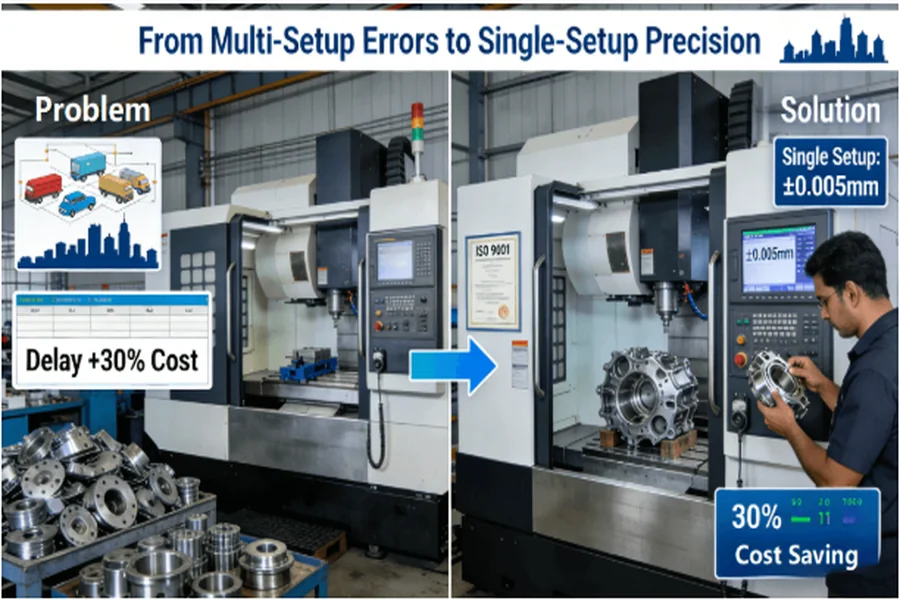
In Pune, a bustling hub for IT and automotive innovation, local manufacturers face a critical challenge: producing high-precision, complex components efficiently. Traditional 3-axis CNC machining often falls short, requiring multiple setups that introduce errors, extend lead times, and inflate costs. For startups and established companies alike, these delays can mean missing crucial market windows and losing competitive ground. The root cause is a lack of manufacturing agility, forcing many Pune businesses to rely on external suppliers and complex supply chains.
This article introduces 5-axis CNC machining as a transformative solution. By enabling the complete machining of intricate geometries in a single setup, this technology directly addresses the core inefficiencies plaguing local production. The following sections will detail how 5-axis CNC works, its specific advantages for Pune’s key sectors, and the path to implementation for achieving significant cost savings and accelerated time-to-market.
What Is 5-Axis CNC Machining and How Does It Differ from Traditional Methods?
5-axis CNC machining is an advanced manufacturing process that adds two rotational axes (typically A and C) to the standard three linear axes (X, Y, Z). This allows the cutting tool to approach the workpiece from virtually any direction in a single, continuous operation. This dynamic capability is the key differentiator from traditional methods.
- The Limitations of Linear Machining: Traditional 3-axis CNC is limited to linear movements. To machine different sides of a part, the workpiece must be manually repositioned and re-fixtured for each new setup. This process not only consumes valuable time but also introduces cumulative positional errors each time the part is moved. For components with features on multiple planes, this method is inherently inefficient and prone to inaccuracies that can compromise the final assembly.
- The Power of Simultaneous Motion: In a 5-axis system, the two additional rotary axes allow for simultaneous movement of the tool and workpiece. This means complex contours, deep cavities, and angled features can be machined without stopping to reposition the part. The tool maintains an optimal cutting orientation, which significantly improves accuracy and surface finish. This continuous operation is fundamental to achieving the “one-and-done” machining philosophy.
- Adherence to Geometric Standards: The ability to machine a part in one setup ensures a consistent datum reference throughout the entire process. This is critical for meeting the stringent geometric dimensioning and tolerancing (GD&T) requirements defined by standards like ASME Y14.5. By eliminating datum shifts, 5-axis machining provides a more reliable and verifiable path to achieving the tight tolerances demanded by industries such as aerospace and medical devices.
What Are the Key Advantages of 5-Axis Machining for Complex Part Production?
The benefits of 5-axis CNC machining extend far beyond simple geometry handling, offering tangible improvements in precision, efficiency, and design freedom that are vital for high-value part production.
1. Unmatched Precision from a Single Setup
The most significant advantage is the elimination of multiple setups. By machining all features in one fixture, human error and cumulative inaccuracies are drastically reduced. This results in superior part quality, with features holding true positional tolerances relative to each other. For businesses in Pune, this means higher first-pass yield and less scrap, directly translating into cost savings and more reliable production timelines.
2. Dramatic Reductions in Machining Time
5-axis technology drastically cuts production time in two ways. First, it eliminates the non-value-added time associated with repositioning parts. Second, it allows for the use of shorter, more rigid cutters that can be run at higher feed rates without vibration. Furthermore, the ability to use the tool’s side for flank milling enables larger step-overs on contoured surfaces, significantly reducing machining time for complex shapes like impellers or molds.
3. Unlocking Design and Material Potential
With the ability to machine undercuts and deep cavities previously impossible in one piece, designers are freed from manufacturing constraints. This allows for part consolidation, where an assembly of several components can be redesigned as a single, stronger, and more reliable unit. This capability is perfectly suited for creating lightweight, high-strength structures from challenging materials like titanium and Inconel, which are common in Pune’s automotive and aerospace sectors.
How Can 5-Axis CNC Technology Address Specific Challenges in Pune’s IT and Automotive Sectors?
Pune’s economic landscape, rich with IT giants and automotive OEMs, presents unique opportunities for 5-axis CNC machining to solve specific, high-stakes production challenges.
1. Accelerating IT Hardware Prototyping
For Pune’s IT and tech startups, speed-to-market is everything. A company developing a new network switch or server enclosure can use 5-axis machining to prototype complex heat sinks and structurally integrated chassis in a single operation. This can compress a prototyping cycle from four weeks to just two, allowing for faster iteration and a crucial competitive edge. Utilizing a 5-axis CNC machining service ensures quick turnaround and close collaboration, avoiding the delays of offshore supply chains.
2. Enhancing Automotive Component Performance
The automotive industry in Pune demands high-performance components like turbocharger impellers and custom sensor housings. These parts feature complex aerodynamics that are inefficient to produce with 3-axis methods. 5-axis machining allows for the creation of these optimized geometries from solid billet, improving performance and fuel efficiency. It also enables the cost-effective low-volume production of specialized tooling and fixtures, supporting the region’s thriving automotive ecosystem.
3. Strengthening Local Supply Chains
By adopting 5-axis technology, Pune-based manufacturers can bring high-value production in-house or source it locally from specialized partners. This reduces dependency on international suppliers, minimizes logistics risks, and shortens lead times. It also fosters a ecosystem of innovation, where local engineers can collaborate closely with machinists to optimize designs for manufacturability (DFM), ensuring the highest quality and performance.
What Should Pune Manufacturers Consider When Implementing 5-Axis CNC Solutions?
Adopting 5-axis machining is a strategic decision. A careful evaluation of needs and capabilities ensures a successful implementation that delivers a strong return on investment.
- Evaluating Project Complexity and ROI: The first step is to analyze your part portfolio. If your designs frequently involve complex contours, multi-sided features, or tight tolerances, the investment is easily justified. A thorough Return on Investment (ROI) analysis should account not only for the machine’s cost but also for the savings from reduced fixtures, shorter cycle times, lower scrap rates, and the potential for new business from advanced capabilities.
- Selecting the Right Technology Partner: Choosing a supplier is critical. Look for a provider with proven expertise, robust technical support, and a clear understanding of your industry’s requirements. The ideal partner will offer comprehensive training and application engineering support to ensure a smooth transition. For businesses in Pune seeking reliability, a high precision 5-axis machining service with relevant certifications is essential for mission-critical projects.
- Emphasizing Quality and Certification: For manufacturers serving regulated industries, the quality management system of their processing partners is just as important as their own equipment. Certifications such as ISO 9001:2015 are essential, ensuring that production processes are standardized, controlled, and continuously optimized. In the automotive and aerospace sectors, certifications like IATF 16949 and AS9100D further guarantee product quality and traceability. By integrating these rigorous control measures into every project, companies ensure compliance and consistent part quality.
Conclusion
5-axis CNC machining is no longer a niche technology but a core competitive advantage for manufacturers in Pune. By enabling single-setup precision, it directly overcomes the limitations of traditional machining, delivering unmatched accuracy, dramatic time savings, and unparalleled design freedom. As Pune continues to grow as a global manufacturing and IT hub, embracing advanced technologies like 5-axis CNC is essential for businesses aiming to accelerate innovation, reduce costs, and strengthen their market position. The journey toward more efficient and agile manufacturing begins with a strategic evaluation of how this powerful technology can be integrated into your operations.
FAQs
Q1: What is the typical lead time for 5-axis CNC machining projects?
A: Lead times vary based on complexity, but with advanced planning, many projects can be completed in 1-3 weeks. Factors like material availability and design optimization play a role; for instance, simple prototypes may ship in days, while complex batches require longer. Businesses in Pune can benefit from local suppliers to reduce delays.
Q2: How does 5-axis CNC machining compare to 3D printing for rapid prototyping?
A: 5-axis CNC offers higher precision and material strength for functional prototypes, whereas 3D printing excels in speed and complexity for non-critical parts. CNC is ideal for metals and tight tolerances, making it suitable for Pune’s automotive sector, while 3D printing suits iterative design checks.
Q3: What materials can be processed with 5-axis CNC machines?
A: Common materials include aluminum, stainless steel, titanium, and engineering plastics. Each material requires specific tooling and parameters; for example, titanium demands slow speeds to avoid heat distortion. This versatility supports diverse applications in IT and medical devices.
Q4: Is 5-axis CNC machining cost-effective for small batches?
A: Yes, due to reduced setup times and tooling costs, 5-axis CNC can be economical for small batches. By minimizing scrap and rework, businesses in Pune can achieve lower per-unit costs compared to traditional methods, especially for high-value components.
Q5: How can I find a reliable 5-axis CNC service provider in Pune?
A: Look for providers with certifications like ISO 9001, experience in your industry, and local support. Evaluate their equipment portfolio and request case studies. For instance, providers offering DFM feedback ensure smoother projects, reducing risks for Pune-based clients.
Author Bio
The author is a precision manufacturing expert at LS Manufacturing, a company that helps engineers and businesses in Pune and beyond solve complex part challenges in the aerospace, medical, and automotive industries. With certifications such as IATF 16949 and AS9100D, the team ensures high-quality solutions through advanced technologies. For more insights, contact them today for a free, no-obligation project review and DFM analysis to turn your concept into a cost-effective reality.