
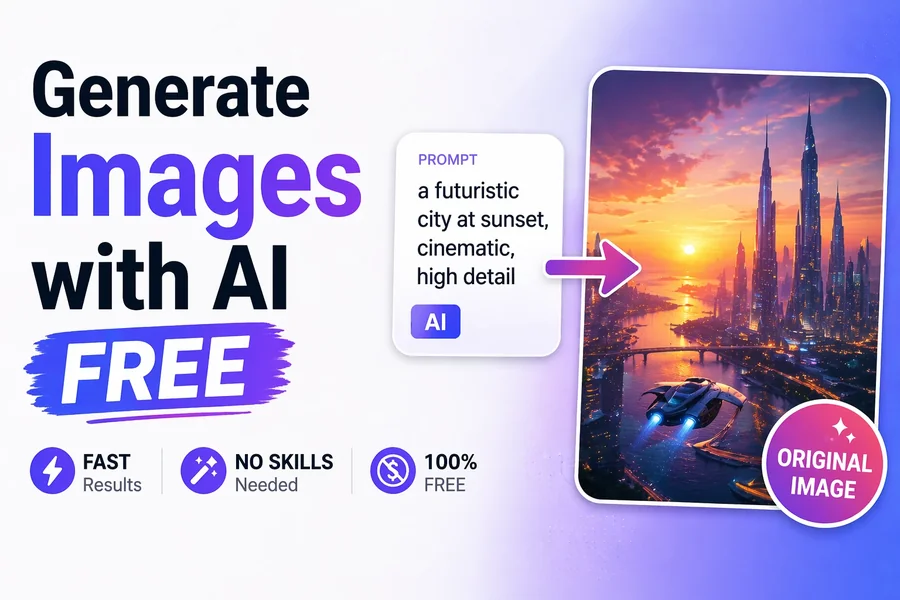
AI image generation has fundamentally changed how people create visual content. What once required a professional photographer, a designer, or hours in Photoshop can now be done in seconds with a text description. Whether you need images for social media, marketing, a presentation, or a creative project — an generate images with AI free tool makes it possible without design skills, without expensive software, and without spending anything.
How AI Image Generation Works
AI image generation is based on a technology called text-to-image synthesis. A machine learning model — trained on millions of images and their descriptions — learns the relationship between words and visual concepts. When you type a description (called a prompt), the model uses that training to generate a new, original image that matches what you described.
The generation process typically takes between 5 and 30 seconds depending on the tool and the complexity of the image. The result is a completely unique image that has never existed before — not a stock photo, not a template, but something created specifically from your prompt.
What Kinds of Images Can You Generate?
| Image Type | Examples | Use Cases |
| Photorealistic | Portraits, landscapes, product shots, architecture | Marketing, ads, presentations |
| Digital illustration | Flat design, vector-style, editorial art | Blog posts, social media, websites |
| Anime / manga style | Characters, scenes, stylized portraits | Gaming, entertainment, fan art |
| 3D render | Objects, environments, abstract visuals | Product mockups, design prototypes |
| Oil painting / watercolor | Artistic landscapes, portraits, still life | Prints, gifts, creative projects |
| Minimalist / abstract | Geometric shapes, color gradients, patterns | Backgrounds, branding, wallpapers |
The Difference Between AI Generation and Stock Photos
Stock photos are real photographs taken in real settings, licensed for use. AI-generated images are synthetic — created entirely by a machine learning model based on your description. This distinction matters for several practical reasons:
- Uniqueness — AI images are original every time. Stock photos are used by thousands of different people and projects simultaneously.
- Specificity — you can describe exactly what you need, down to the lighting, setting, mood, and composition. Stock photos require you to search through what already exists.
- Cost — quality stock photos often require licensing fees. AI generation is available for free with no per-image cost.
- Speed — generating an AI image takes seconds. Finding the right stock photo can take much longer.
- Flexibility — if the result isn’t perfect, you refine the prompt and generate again. Stock photos can’t be adjusted.
How to Write Prompts That Actually Work
The quality of your AI-generated image depends almost entirely on how well you describe it. A vague prompt produces a generic result; a specific, detailed prompt produces something close to what you actually imagined.
The most effective prompts combine several elements: the main subject, the setting or context, the visual style, the lighting, and the mood or atmosphere. Each of these elements gives the AI more information to work with and narrows down the range of possible outputs to match your vision.
| Prompt Component | Weak Example | Strong Example |
| Subject | a person | a middle-aged woman with curly red hair |
| Setting | outside | standing in a sunlit wheat field at golden hour |
| Style | realistic | photorealistic, cinematic, 35mm film |
| Lighting | (not specified) | warm golden backlight, long shadows |
| Mood | (not specified) | peaceful, contemplative, soft and quiet |
Step-by-Step: Generate Your First AI Image
Step 1: Open Phototune.ai and go to the AI image generator. No account or sign-up required — start immediately.
Step 2: Type your prompt in the text field. Start with the main subject, then add style, lighting, and mood. The more specific you are, the better the result.
Step 3: Click generate. The AI processes your prompt and creates an image in seconds.
Step 4: Review the result. If it doesn’t match your vision, adjust the prompt. Try adding or removing specific words, changing the style descriptor, or being more precise about a particular element.
Step 5: Download the image and use it immediately. No watermarks, no restrictions.
Common Mistakes and How to Avoid Them
- Too vague — ‘a nice photo’ gives the AI nothing to work with. Always describe what you actually want to see.
- Contradictory instructions — ‘dark and bright, modern and vintage’ confuse the model. Choose one direction.
- Giving up after one attempt — AI generation is iterative. Most great results come after 2–3 prompt refinements.
- Ignoring style keywords — words like ‘photorealistic’, ‘cinematic’, ‘watercolor’, or ‘3D render’ dramatically change the visual output and should always be included.
- Not specifying aspect ratio — if you need a specific format (square for Instagram, widescreen for a presentation), mention it in the prompt or select it in the tool settings.
Who Benefits Most from AI Image Generation
Content creators and social media managers produce large volumes of visual content on tight schedules. AI generation removes the bottleneck of sourcing or creating images for every post, article, or campaign.
Small business owners and entrepreneurs often don’t have the budget for professional photography or a design team. AI generation gives them access to professional-quality visuals for their websites, ads, and marketing materials at zero cost.
Designers and marketers use AI generation for rapid prototyping — generating concept visuals, testing different visual directions, and communicating ideas to clients before committing to final production.
Writers and bloggers need header images, featured photos, and article illustrations. AI generation lets them create visuals that match their content precisely, rather than settling for generic stock photos.
Phototune.ai’s AI image creator online free is available directly in your browser — no account, no payment, no software. Type your prompt, generate your image, and download the result in seconds. It’s the fastest way to go from an idea to a finished visual.